Feature
Your agent file, without the agent file
Every CLAUDE.md, AGENTS.md and .cursorrules is paid for on every single turn, and past a certain size the model stops following it anyway. MenteDB ingests the file once, turns every rule into an atomic memory, and delivers the right rules at the right moment: by relevance, at the exact tool action they govern, by the activity they describe, and in a review pass against what the agent actually wrote.
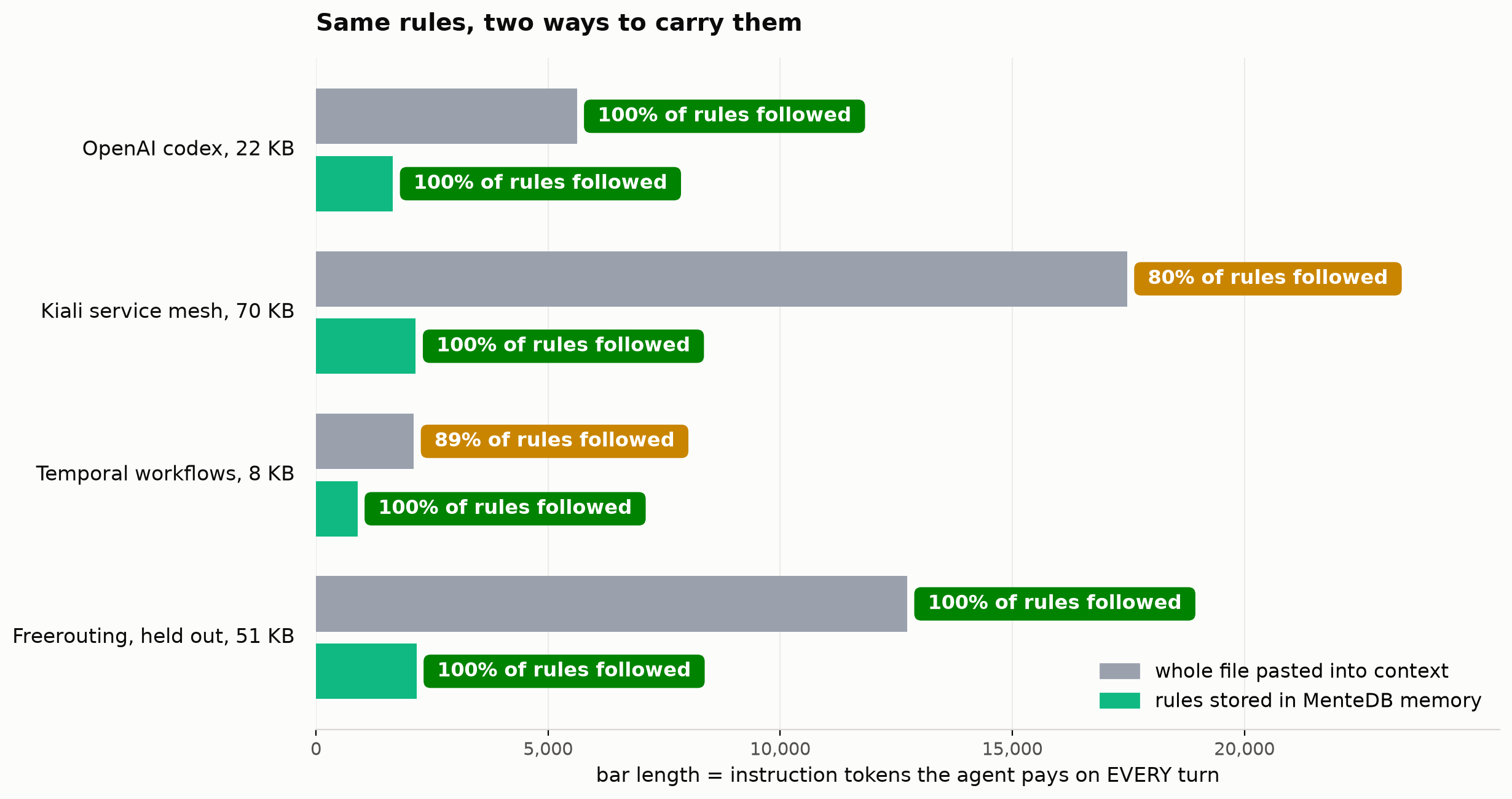
Measured, not promised
Four real public agent files, rules checked by plain string predicates, five trials, and a no instructions control. One file was held out completely and scored 100 percent on the first run. The full method, fixtures and runners are public.
| file | whole file in context | MenteDB | nothing |
|---|---|---|---|
| OpenAI codex, 22 KB | 100% at ~5,600 tokens per turn | 100% at ~1,700 tokens | 27% |
| Kiali, 70 KB | 80% at ~17,500 tokens per turn | 100% at ~2,200 tokens | 40% |
| Temporal, 8 KB | 89% at ~2,100 tokens per turn | 100% at ~900 tokens | 22% |
| Freerouting, 51 KB, held out | 100% at ~12,700 tokens per turn | 100% at ~2,200 tokens | 22% |
How it works
- One call ingests the file, any format, any language. Large files parse in the background and you poll a job id.
- Rules become atomic, self contained memories with action triggers, section tags and activity exemplars. Nothing is pinned to every prompt.
- Delivery runs through four channels: relevance injection, action rules at the tool moment, mode activation for standing directives, and cluster completion for dense rule sections.
- The review pass retrieves again against what the agent wrote, which catches the rules whose relevance only exists in the output.